 CATEGORIES
Blogs
Choosing light bulbs: lumen and watt let's clarify

Lumens and watts: what are they? Can they help me choose the bulbs? Here is the comparison table that allows you to compare LED bulbs with halogen, incandescent and neon bulbs.
When you have to choose which bulbs to buy, not everyone knows how to buy the right bulb: which bulb? LEDs? How many Watts? How many Lumens?
I need to replace a light bulb: which bulb to choose? Is a halogen, neon or LED bulb better?
The secret to choosing the correct light bulb is compare bulbs based on lumens.
But what are lumens? And how many lumens does my bulb have?
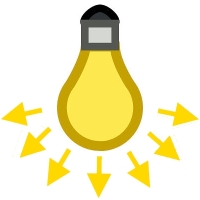
Lumens are the unit of measurement of the luminous flux of a lighting source, therefore they indicate the quantity of light that our bulb is able to emit in all directions.
What are Watts? What information do they give me when choosing bulbs?
The Watts they measure the power of the bulbs, and tell me so how much will my light bulb consume. Typically for traditional, incandescent or halogen bulbs, a higher power (Watt) corresponded to greater illumination: for modern LED bulbs this is no longer true: even with a few Watts we get good lighting.
It is important to know that it is not enough for a light bulb to be very powerful to offer good lighting: what matters are the lumens.
Depending on the technology, each bulb, with the same power, is able to provide more or less quantity of light.
Here is a practical summary table which, based on the technology of each bulb, tells us a how many lumens correspond to the power in Watts.
| 405 lumens | 700 lumens | 1,175 lumens | |
|---|---|---|---|
| Incandescence | 40W | 60W | 100W |
| Halogen | 30W | 46W | 70W |
| Neon | 9W | 12W | 20W |
| Led | 5W | 8W | 12W |