 CATEGORIES
Blogs
Make the Above Ground Pool Like New


With the arrival of the first warm weather for those who have a swimming pool, thoughts immediately turn to making a first bathroom with family or friends. Both for those who above ground swimming pool left it assembled, both for those who stored it in the box during the winter season, before using it is getting back on track is essential and ensure the right maintenance, so that they are limited as much as possible problems for the summer period.
Why is it essential?
There preventive cleaning of the above ground pool from algae or residues of dirt that have formed on the bottom and walls during the winter season is the most important. Whether the pool is left in the garden or in the case of winter storage.
If the cleaning and the impactful treatment with chemical products it is not done once filled with water, it will be really difficult to do it with good results during the season especially with the increase in atmospheric temperatures.
For those who have an above ground pool already installed Shock treatment with chlorine is important before use.
The assembly of above ground pools must be just as careful as the cleaning of the cover. In fact, it is necessary to ensure that the bottom where the pool will be located is suitable to support it and free from sharp objects that could damage the bottom of the above ground pool.
Where to start from?
1. Bottom stability and removal of sharp objects
For those who assemble and disassemble the bike every year above ground swimming pool you need to flatten the bottom as much as possible, cut the grass and make sure that they are not there branches or small objects pointed which are very dangerous for the fabric. A small, slightly sharp object, with the weight of water, makes the sheet much more tense and vulnerable.
Our experience teaches us that even just a harmless pin could pierce the sheet after filling the pool.
The ideal area for the assembly of above ground swimming pools always remains one concrete platform to give stability and leveling to the ground. In case you don't want to create a concrete pad, if you have a well compacted soil over time and it it is leveled with fine sand the result, however, would allow you to have an above ground swimming pool that is firmly on the ground and level. Towels to place on the ground are supplied with the swimming pools, but they are often not enough.
Because of this we always recommend a surface with synthetic grass or special polyethylene tiles capable of creating a barrier against materials that would damage the pool.

Prisma Intex 732x366x132 on polyethylene top, covered with cloth
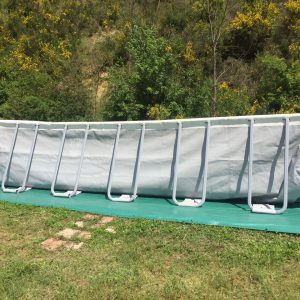
Prisma Intex 732x366x132 on polyethylene top, covered with cloth
2. Cleaning the sheet
The cover should be cleaned every time above ground swimming pool is dismantled so as not to allow dirt to anchor to it during the winter period. In any case, cleaning before putting the water back on is necessary.
What is needed?
✓ Brush with soft plastic bristles.
✓ Degreaser specific for plastic materials. Even a traditional degreaser can work.
✓ Algaecide mixed with water.
✓ Idrop washer, alternatively a normal jet of water is also fine. it can save time. Of course you need to set the appropriate power.
First of all you have to clean the above ground pool cover using the brush with soft bristles, use the appropriate degreaser to eliminate all traces of grease and dirt. We always recommend using thealgaecide mixed with water to eliminate any presence of algae. Finally, use the pressure washer to rinse the cover.
3. Assembly of the above ground swimming pool
Above ground swimming pool frame: If you are dealing with a frame above ground pool, i.e. with a metal structure, the assembly of the tubular skeleton can be facilitated by the application of talcum powder on the frame tubes, this greatly facilitates their sliding inside the canvas, speeding up operations.
Self-supporting above ground swimming pool: For self-supporting above ground pools the operations are simpler, in fact after inflating the perimeter ring you can start filling the pool without any particular problems, keeping an eye on, however, that the water level causes the ring to rise uniformly without leaks of water.
4. Filling the above ground pool
It's important contact certified operators for full filling of the pool, they guarantee work in accordance with the law and the use of balanced and ready-to-use water.
For those who just need to top up the water level, we recommend filling it with water from the aqueduct. Since it is controlled at the source it guarantees more balance between its chemical components. Water coming from wells or cisterns involves more difficult balancing work, not always with optimal results.
After filling the above ground pool to the optimal level, you need to understand the state of your water by doing a pH and chlorine test. The best test is the one in which two small vials are filled with water and made to react with specific liquids which give a reliable chlorine and pH value. (swab strip tests are less reliable).
In all likelihood the water will be chlorine deficient and the pH will need to be corrected. In these cases we use the so-called "shock treatments”. We recommend placing granular chlorine in a container with water (so that the granular chlorine does not end up directly on the bottom of the pool as it could stain the towel) with the quantity recommended on the product label and mixing them. Once mixed they must be inserted into the water of the above ground pool. The control of pH varies depending on what type of "hardness" it has and can be easily corrected with products capable of raising or decreasing the hardness level inside your above ground pool.
If water is added at the beginning of the year, we recommend changing approximately 1/3 of the pool water and carrying out the necessary Chlorine and PH tests. Naturally, cleaning the walls must be carried out before adding water so that the incoming water is "purified" and not affected by algae resulting from cleaning.
5. Installation of the pump, flocculant and anti-algae
Lastly, you need to connect the pump to the above ground pool. Each pump has specific functions: the main ones are the filtering which allows the water to be constantly filtered by the filtering system (with cartridge filter for medium/small pools, with quartz sand - in some cases with glass crystals - for medium/large ones) and the backwashing which allows you to clean the filter system.
If the water is a little cloudy both during assembly and during use in season, it is advisable to use flocculant.. The flocculant is a product to be added to the above ground pool water in the doses appropriately indicated in the product packaging. The function of the flocculant is to bind through a chemical process with the sand inside the pump, contributing to the elimination of the particles which are one of the causes that make the water in the above ground swimming pool cloudy. Thanks to this liquid, the quartz sand will increase the filtering effectiveness and after 4/5 hours after adding the flocculant it is necessary to carry out a backwash to free the sand from the latter.
If algae appear, it becomes necessary to use anti-algae, easily available in DIY and specialized stores. Anti-algae is a product that is found both in liquid and solid form (in the form of tablets) and by constantly adding it to the pool it prevents the formation of algae.
It can be also used to eliminate algae present on the walls of above ground swimming pools. Both when they are already assembled and in the process of winter storage.